
Be Our Guest: Feasting at the Tables of Fairy Tale
by Kelly Jarvis

We’ve all heard the warnings: if you find yourself in the realm of Faerie, do not eat the food. “We must not look at goblin men, / We must not buy their fruits: / Who knows upon what soil they fed / Their hungry thirsty roots,” Lizzie famously cautions her sister Laura in Christina Rosetti’s sumptuous poem Goblin Market. The food of Faerie is so fraught with danger that one bite can doom us to death, but the food of fairy tale, conjured from ingredients of the mortal realm, is sustenance of a different sort. Red-cheeked apples, bowls of porridge, and anthropomorphized gingerbread men invite us to partake in nourishing feasts for the soul. Fairy tale food may function as a test or serve as a reward, but it always helps us understand the aching hunger of human life.
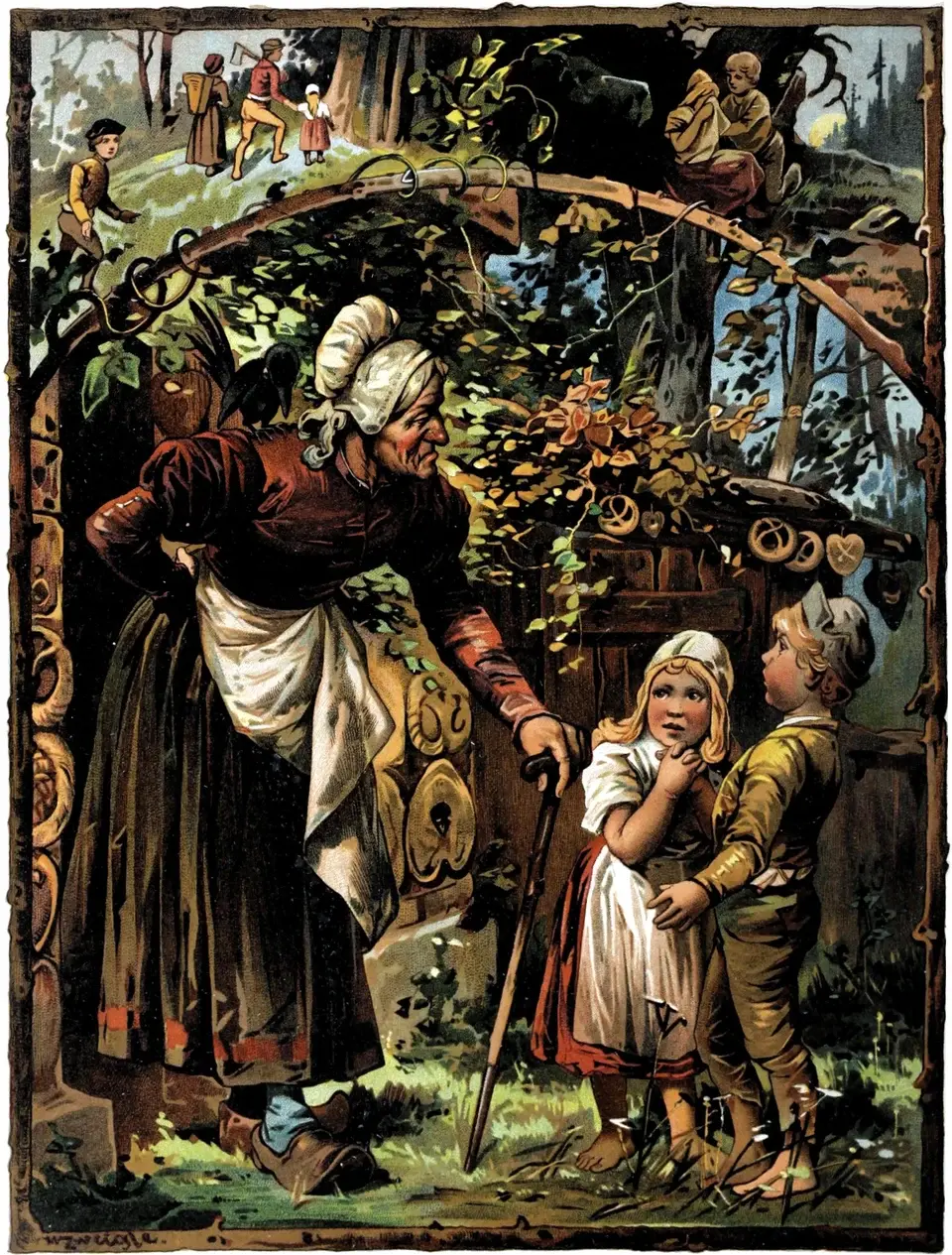
You need not look far to find hunger rumbling beneath the surface of fairy tales. The Beast, knowing Beauty must eat in order to live, courts her over a series of lavish suppers, and when a famine comes to the edge of the forest where Hansel and Gretel reside, hunger forces their parents to abandon them in the woods just as it prompts the children to devour the sugary roof and windows of the witch’s house. In The Three Wishes, an English fairy tale, hunger proves to be an even greater temptation than the promise of wealth. The story’s protagonist, a poor woodcutter, is gifted three wishes for sparing a tree favored by a fairy, and he wishes for a sausage to fill his hungry belly. When his wife angrily responds by wishing the sausage would get stuck to the end of his nose, he must use his third and last wish to put things right. The couple ends their story no richer than when they began, but “they had at least as fine a black pudding for their supper as the heart of man could desire.”
Not all hungry protagonists prioritize their rumbling stomachs, however, which forces us to consider the social and emotional aspects of fairy tale food alongside the physical ones. In the Brothers Grimms’ The Star Talers, an orphaned girl with nothing to her name gives her last piece of bread to a hungry beggar, and in the Russian story Vasilisa the Beautiful, collected by Alexander Afanasyev, the heroine’s mother advises her to always feed her doll before asking it for help or advice. Because both girls follow the rules of hospitality and share their food with others even when they are desperately hungry themselves, the universe rewards them; the orphan is showered with silver coins and Vasilisa marries the czar. Fairy tales teach us that food is more than nutrition. Food fuels our human connections, and sharing our food with those in need satiates us far more than calories ever could.
If fairy tale food can be more than simple sustenance, then it stands to reason that fairy tale hunger can be more than physical pain. The Grimms’ Little Snow-White, well fed by the dwarfs and polite enough to eat “only a few vegetables and a little bread from each little plate” when she first arrives at their woodland cottage, is not tempted by physical hunger alone. She eats the “poisoned, poisoned apple,” but she also accepts the corset and comb offered by the beggar woman, and this implies her motivation goes beyond bodily craving.

Although we don’t learn why Snow-White “longed for the beautiful apple,” her actions illustrate either her desire to possess objects associated with femininity or her longing to connect with the woman who bestows them. The queen in Tatterhood, a Norwegian fairy tale collected by Asbjørnsen and Moe, also has plenty of food to eat, but that doesn’t stop her from hungering for a child. She is so ravenous for motherhood that she eats two magical flowers to aid her conception, eventually giving birth to a mismatched pair of twins. And then there is Little Red Riding Hood, who begins her story by bringing a basket of food to her ailing grandmother only to end up becoming a meal for a hungry wolf. The wolf’s attack, which takes place when the girl is naked in bed, links his physical hunger to sexual desire, once again showing us that consumption in fairy tales can be about far more than simply filling our stomachs.
"Just as fairy tale food can exhibit human characteristics, so too can fairy tale characters be reduced to food."
Since fairy tales are steeped in wonder, the food, and the instruments used to cook the food, like the pot in Sweet Porridge or the oven that harbors a cursed prince in The Iron Stove, sometimes feature as fully rounded characters. In Frau Holle, a loaf of bread begs to be taken out of the oven, and the kind girl who performs the task is covered in gold while the unkind girl who refuses gets doused with pitch. When Hans Christian Andersen’s Little Match Girl is alone in the cold, she imagines a “great iron stove with shining brass knobs and a brass cover” and a “roast goose” who “jumped down from the dish and waddled along the floor.” And we can’t forget The Gingerbread Boy, a child baked from dough who runs away from the people and animals who try to eat him. By anthropomorphizing food, fairy tales further sensitize us to its complex function, revealing the emotional labor at the core of human meals. Fairy tale food does not appear as if by magic, though there is magic in its making. It is concocted of humble ingredients gathered in our very own fields, and if it must be eaten, it should be savored like a cherished story passed down through generations of kin.
Just as fairy tale food can exhibit human characteristics, so too can fairy tale characters be reduced to food. Witches, wolves, and ogres from tales like Little Thumb and Jack and the Beanstalk salivate for human flesh, but even mothers have a penchant for cannibalistic behavior; Snow-White’s mother tries to eat her daughter’s lungs and liver, Sleeping Beauty’s mother-in-law has her grandchildren cooked in a “piquant sauce,” and the step-mother in The Juniper Tree murders a boy and serves him to his father in a stew. Frightening though these villains may be, each is defeated by simple trickery or divine retribution, their downfalls issuing strict warnings against the dangers of uncontrolled appetites.
Fairy tale food is, after all,
more than a tool to nourish hungry bodies.
Sadly, the villains who metaphorically feast upon fairy tale characters are harder to defeat, as shown in the Brothers Grimm tale Rapunzel. Like Giambattista Basile’s Petrosinella, Rapunzel is named for the herb her birth mother craves during pregnancy. The craving is so fierce, she trades her unborn baby for a handful of lettuce, and when the child turns twelve, she is locked in a tower on the whim of a sorceress who “eats” the girl’s freedom like candy. Even animated variants maintain a subtle connection between the girl and an edible herb; in Disney’s Tangled, Rapunzel is gifted with healing powers when her pregnant mother drinks tea created from a magical flower. Mother Gothel, who has long depended on the flower to maintain her youthful appearance, steals the queen’s newborn baby, affectionately referring to her as “flower.” Like the item of food after which she is always named, each Rapunzel character is devoured by those who crave her innocence, and while the girls eventually escape their towers, the villains who feast upon them don’t always receive the comeuppances they deserve.
Perhaps no fairy tale villain brings us to the frightening thresholds of consumption and digestion more than Baba Yaga, the wild witch of the Slavic woods, for unlike the wolves and ogres who are the antagonists of fairy tales, Baba Yaga remains morally neutral, helping or harming visitors as her personal desires direct. Her house roams through the forest on chicken legs (the primary ingredient in soup), and she flies through the air in her mortar and pestle while disembodied servants cook her meals and mix her potions. Baba Yaga uses food to test protagonists’ mettle, forcing maidens to milk bear-cows and separate seeds from peas. “If you do not do it, I shall eat you up,” she warns, a threat made more terrifying by her voracious appetite. Baba Yaga would rather gorge herself on stews, meats, and mugs of kvass than conform to the rules of polite dining etiquette, and her boldness reminds us that we all must eat our fill at the beautiful banquet of human life.
Fairy tale food is, after all, more than a tool to nourish hungry bodies. It is the pea that proves who we truly are and the bean that carries us to castles in the sky. It is the walnut that hides our dresses and the pumpkin that delivers us to our happily-ever-after. It is the basket of goodies that heals us, the match-lit memory that comforts our grief, and the breadcrumb trail that leads us back to the transformative magic found in the kitchens of our very own homes.

This article first appeared in "Ravenous; Food in Fairy Tale" our November 1, 2026 issue of The Fairy Tale Magazine. Download the full issue here.
Kelly Jarvis works as the Contributing Writer for The Fairy Tale Magazine, is a Recurring Columnist for Eternal Haunted Summer, and teaches writing and literature at Central Connecticut State University. Her work has been featured in a moon of one’s own, Blue Heron Review, Corvid Queen, Mermaids Monthly, The Chamber Magazine, The Magic of Us, and Mothers of Enchantment: New Tales of Fairy Godmothers. She is the author of Selkie Moon and Sea and Stars. Connect with her on Facebook (Kelly Jarvis, Author) or Instagram (@kellyjarviswriter) or visit her at https://kellyjarviswriter.com/


